585 Watt Solar Panel Price in Pakistan 2026 — Brand-Wise Rates, Specs & Complete Buyer Guide
| ⚡ Quick Answer: The 585 watt solar panel price in Pakistan in June 2026 ranges from Rs. 23,400 to Rs. 29,835 per panel for A-Grade Tier-1 brands. On a per-watt basis, Trina Solar and AstroEnergy start at Rs. 40, LONGi and JA Solar are priced at Rs. 44–48, Jinko Solar at Rs. 45–47, and Canadian Solar at Rs. 49–51 per watt. Prices vary by technology, brand, documentation, and city. |
Pakistan’s solar market in 2026 is operating at a pace no one could have predicted five years ago. With electricity tariffs at historic highs and load-shedding still a daily reality for millions of households and businesses, the shift to rooftop solar has become less of a lifestyle choice and more of a financial necessity. The 585 watt solar panel has emerged as the sweet spot in this landscape — powerful enough to make a meaningful dent in electricity bills, yet still affordable compared to the larger 615W and 645W modules now entering the market.
This guide covers everything a buyer in Pakistan needs in 2026: the freshest brand-wise prices updated to June 2026, technical specifications for every major model, how many panels a home actually needs, installation cost breakdowns, and the critical NEPRA policy shift that every solar buyer must understand before signing on the dotted line with an installer.
Why 585W Panels Are Still Pakistan’s Best-Selling Modules in 2026
A few years ago, 545W and 550W were the standard sizes stocked by dealers across Hall Road in Lahore, Saddar in Karachi, and Blue Area in Islamabad. The shift to 585W has been driven by practical economics: more watts per panel means fewer panels needed on the roof, which in turn reduces mounting hardware costs, wiring length, and labour time. A standard 5kW system now needs just 9 panels at 585W compared to 14 panels at the older 380W size — a significant saving in structural and installation expenses.
Beyond the numbers, the move to N-Type TOPCon and HPBC cell technology has transformed what a 585W panel can actually deliver. Efficiency ratings between 21.5% and 22.65%, combined with degradation rates as low as 0.25% per year, mean these panels will still be producing near-full output well into the 2040s. In a country where rooftop temperatures regularly exceed 50 degrees Celsius in cities like Multan, Sukkur, and Jacobabad, the improved temperature coefficient of N-Type cells — just -0.29°C per degree compared to -0.35°C for older P-Type panels — translates into measurably better summer performance.
585 Watt Solar Panel Price in Pakistan — Brand-Wise Comparison (June 2026)
The prices below represent current A-Grade, Tier-1 documented panels available through authorised dealers and licensed installers across Pakistan as of June 2026. Rates are subject to daily fluctuation based on the PKR/USD exchange rate, import duty adjustments, and regional dealer margins.
| Brand | Model / Series | Technology | Per Watt (PKR) | Panel Price (PKR) | Warranty |
| Jinko Solar | Tiger Neo 3.0 | N-Type TOPCon Bifacial | Rs. 45–47 | Rs. 26,325–27,495 | 30 Yr Performance |
| LONGi Solar | Hi-MO 6 (HPBC) | N-Type HPBC Single Glass | Rs. 44–45 | Rs. 25,740–26,325 | 25 Yr Performance |
| LONGi Solar | Hi-MO X10 (HPBC 2.0) | N-Type HPBC 2.0 Anti-Glare | Rs. 47–48 | Rs. 27,495–28,080 | 25 Yr Performance |
| Canadian Solar | TOPBiHiKu6 N-Type | N-Type TOPCon Bifacial | Rs. 49–51 | Rs. 28,665–29,835 | 25 Yr Performance |
| JA Solar | DeepBlue 4.0 N-Type | N-Type TOPCon Bifacial | Rs. 44–44.50 | Rs. 25,740–26,032 | 25 Yr Performance |
| Trina Solar | Vertex S+ N-Type | N-Type TOPCon Mono | Rs. 40–44 | Rs. 23,400–25,740 | 15+10 Yr Warranty |
| AstroEnergy | CHSM Series N-Type | N-Type TOPCon Bifacial 20BB | Rs. 40–42 | Rs. 23,400–24,570 | 25 Yr Performance |
| B-Grade / Local | Various | P-Type Mono | Rs. 18–28 | Rs. 10,530–16,380 | Limited / None |
| ⚠️ Important Pricing Note: Solar panel prices in Pakistan fluctuate daily based on PKR/USD exchange rates, import duties, and dealer stock levels. The rates listed reflect market conditions as of mid-June 2026. Always confirm the latest per-watt rate with your dealer or installer before finalising a purchase. B-Grade panels carry no manufacturer warranty and are not recommended for any permanent installation. |
Top Brands for 585W Solar Panels in Pakistan — Full Model Analysis
1. Jinko Solar 585W Tiger Neo 3.0 — Best for Maximum Output Per Square Foot
Jinko Solar’s Tiger Neo series has held the top position in Pakistan’s premium residential solar market for the past several years, and its Tiger Neo 3.0 confirms why. Built on N-Type TOPCon cells with SMBB (Super Multi Busbar) technology, the Tiger Neo 3.0 reduces internal electrical resistance and improves light capture across the panel surface. The bifaciality factor of approximately 85% means the panel harvests additional electricity from reflected light off the roof surface or ground — a genuine advantage on white-painted or concrete rooftops common across urban Pakistan.
Efficiency: Up to 22.27% Degradation Rate: 0.40% per year (linear) Temperature Coefficient: -0.29°C — outperforms in Pakistan summers Warranty: 30-year linear power performance guarantee (industry-leading) Verification: Jinko FlashTrack App — scan QR or serial number before accepting delivery Price in Pakistan (June 2026): Rs. 45–47 per watt → approximately Rs. 26,325–27,495 per panel Best For: DHA, Bahria Town, Gulberg — high-end residential rooftops where space is limited and long-term output is the priority.
Jinko’s distribution network is the widest of any foreign solar brand in Pakistan, which means availability is rarely an issue even during peak installation season. The 30-year performance warranty — five years longer than most competitors — is a significant differentiator for buyers planning to hold their property for decades.
2. LONGi Solar Hi-MO 6 & Hi-MO X10 — Best Value With Cutting-Edge HPBC Technology
LONGi is the world’s largest monocrystalline silicon producer and one of the most widely trusted names among installers across Pakistan. In 2026, two models dominate the 585W segment: the Hi-MO 6 (HPBC single glass) and the newer Hi-MO X10 (HPBC 2.0 with Anti-Glare, Anti-Shading properties).
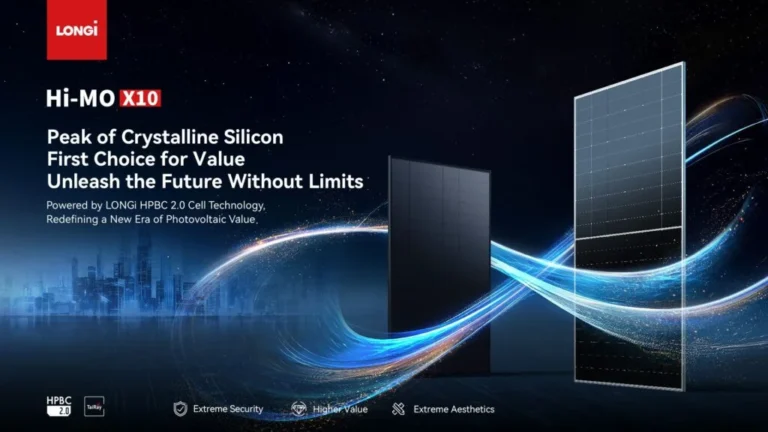
The Hi-MO X10 represents LONGi’s most advanced HPBC (Hybrid Passivated Back Contact) architecture to date. Its anti-glare coating and enhanced shading tolerance make it particularly suitable for rooftops with partial shading from nearby structures or trees — a very common scenario in dense urban environments like Lahore’s residential colonies and Karachi’s commercial zones.
Hi-MO 6 Efficiency: Up to 22.0% | Price: Rs. 44–45 per watt (~Rs. 25,740–26,325) Hi-MO X10 Efficiency: Up to 22.5% | Price: Rs. 47–48 per watt (~Rs. 27,495–28,080) Degradation Rate: < 0.40% per year on Hi-MO 6; < 0.35% on Hi-MO X10 Warranty: 25-year linear performance guarantee Best For: Mid-to-upper range residential setups looking for the ideal blend of technology and cost.
3. Canadian Solar TOPBiHiKu6 N-Type — The Reliable Commercial Workhorse
Canadian Solar’s TOPBiHiKu6 N-Type bifacial panels occupy the premium end of the Pakistani market. With one of the highest listed efficiencies in the 585W category — up to 22.4% — and a robust build quality praised by commercial installers for structural integrity, these panels are the preferred choice for factories, textile mills, office buildings, and large commercial rooftops.
In 2026, Canadian Solar has extended its lineup to include HJT (Heterojunction Technology) panels that push efficiency even further. While HJT panels command a premium above standard TOPCon pricing, they offer measurably better performance in extreme heat — an increasingly relevant consideration given Pakistan’s rising summer temperatures.
TOPCon Efficiency: Up to 22.4% | Price: Rs. 49–51 per watt (~Rs. 28,665–29,835) HJT Technology: Even higher efficiency, better heat performance — premium pricing applies Warranty: 25-year performance guarantee Best For: Commercial installations, large factory rooftops, and buyers who prioritise long-term structural reliability over upfront savings.
4. JA Solar DeepBlue 4.0 N-Type — Excellent Documentation at a Competitive Price
JA Solar’s DeepBlue 4.0 N-Type bifacial range sits in a compelling position in Pakistan’s 2026 market. Priced at Rs. 44–44.50 per watt, these Tier-1 certified N-Type TOPCon panels offer documented performance guarantees at a price point notably below Jinko and Canadian Solar. JA Solar’s track record in Pakistan’s residential and light commercial market has grown significantly over the past two years, with strong availability across major urban markets.
Efficiency: Up to 22.1% Price: Rs. 44–44.50 per watt (~Rs. 25,740–26,032 per panel) Warranty: 25-year linear performance Best For: Budget-conscious buyers who still require Tier-1 documented N-Type panels with a solid warranty structure.
5. Trina Solar Vertex S+ N-Type — Budget-Friendly Tier-1 With Longest Product Warranty
Trina Solar’s Vertex S+ panels bring N-Type TOPCon technology to Pakistan’s more price-sensitive segment at Rs. 40–44 per watt — making them one of the most affordable Tier-1 N-Type options currently available. What sets Trina apart is its 15-year product (workmanship) warranty combined with a 25-year performance guarantee — the longest product warranty term among the brands covered here.
Trina’s panels are physically larger than some competitors, so buyers should measure their roof dimensions carefully before committing to a specific panel count. The larger format does, however, mean fewer mounting points and marginally lower installation labour costs.
Efficiency: Up to 21.8% Price: Rs. 40–44 per watt (~Rs. 23,400–25,740 per panel) Warranty: 15-year product + 25-year performance (best product warranty in class) Best For: Buyers seeking documented Tier-1 N-Type panels at the most competitive price without sacrificing quality.
6. AstroEnergy (CHSM) N-Type TOPCon 20BB — The Rising Alternative
AstroEnergy — the module brand of CHINT Solar — has gained notable market traction in Pakistan in 2026. Its N-Type TOPCon Bifacial panels with 20 Busbar (20BB) cell technology are priced at Rs. 40–42 per watt, positioning them competitively alongside Trina Solar. The 20BB configuration reduces shading losses from the busbars themselves, improving effective output in real-world roof conditions.
Technology: N-Type TOPCon Bifacial, 20 Busbar Price: Rs. 40–42 per watt (~Rs. 23,400–24,570 per panel) Warranty: 25-year performance Best For: Buyers looking for a newer brand alternative at Trina-competitive pricing with solid Tier-1 credentials.
N-Type TOPCon vs P-Type PERC — Which 585W Panel Should Buyers Choose in 2026?
The most common confusion point for first-time solar buyers in Pakistan is the technology difference between N-Type and P-Type panels. The question matters more in 2026 than ever before because both types are readily available, but their long-term performance gap is significant.
| Feature | N-Type TOPCon / HPBC (Recommended) | P-Type Mono PERC (Older Tech) |
| Efficiency Range | 21.5% – 22.65% | 19.5% – 21% |
| Annual Degradation | < 0.25% per year | ~0.45–0.55% per year |
| 25-Year Output Advantage | 8%–12% more energy than P-Type | Baseline reference |
| Heat Performance | Better (Temp coeff. -0.29°C) | Standard (-0.35°C) |
| Low-Light Response | Excellent — generates in shade | Good — standard performance |
| Bifacial Compatibility | Yes — adds 10–25% output gain | Limited models |
| Typical Market Price | Rs. 40–51 per watt | Rs. 27–35 per watt |
| Verdict for Pakistan 2026 | ✅ Best long-term ROI | ⚠️ Only if budget is very tight |
The practical verdict is clear for Pakistani conditions: N-Type TOPCon and HPBC panels are worth the Rs. 5–10 per watt premium in almost every scenario. Over a 25-year installation life, the 8–12% additional output advantage of N-Type panels — compounded with their slower degradation — translates into hundreds of thousands of rupees in additional electricity generation value. Given that Pakistan’s electricity tariff is expected to remain high or increase further, this output advantage becomes even more financially meaningful over time.
Also Read: Solar Panel Per Watt Price in Pakistan 2026
Monofacial vs Bifacial 585W Panels — What Pakistani Buyers Need to Know
A monofacial panel captures solar energy only through its front glass surface. A bifacial panel uses transparent rear glass (or a dual-cell architecture) to additionally collect light reflected from the surface beneath the panel — the roof, white paint, concrete, or light-coloured gravel.
In Pakistani rooftop conditions, a bifacial 585W panel installed with at least 30cm clearance and a slight tilt can generate 10–25% more annual energy than a comparable monofacial panel. Bifacial panels currently carry a price premium of approximately Rs. 3,000–5,000 over monofacial equivalents of the same brand and wattage, but their additional output typically justifies this cost within three to four years.
Important installation note: Bifacial panels only deliver their rear-side generation benefit when properly elevated above the roof surface. Panels flush-mounted directly on a dark roof do not benefit meaningfully from bifacial technology. If an installer is offering bifacial panels without discussing mounting height, that is a red flag worth raising.
How Much Electricity Does One 585W Solar Panel Generate in Pakistan?
Pakistan receives an average of 4.5 to 5.5 peak sun hours per day depending on city, season, and latitude. The table below uses a conservative 5 peak sun hours — a reasonable estimate for most urban areas across Punjab, Sindh, and Khyber Pakhtunkhwa throughout the year.
| Metric | Calculation | Result | Note |
| Daily Output — 1 Panel | 585W × 5 sun hrs | ~2.9 kWh/day | Conservative estimate |
| Monthly Output — 1 Panel | 2.9 × 30 days | ~87 units/month | Varies by season |
| Annual Output — 1 Panel | 87 × 12 months | ~1,044 units/year | Before system losses |
| Daily Output — 10 Panels | 2.9 kWh × 10 | ~29 kWh/day | ~6kW system |
| Monthly Output — 10 Panels | 29 × 30 days | ~870 units/month | Approximate |
| ☀️ Regional Sun Hours: Multan, Sukkur, Bahawalpur, and Dera Ghazi Khan receive 5.5–6 peak sun hours during summer months — meaning actual daily output per panel in these cities can reach 3.2–3.5 kWh. Lahore and Islamabad average closer to 4.8–5.2 hours, while Karachi’s coastal climate can reduce peak sun to 4.5–5 hours in monsoon season. |
How Many 585W Solar Panels Does a Pakistani Home Need? — System Size Guide
The most practical starting point is the monthly electricity consumption shown on a WAPDA or DISCO bill (LESCO, IESCO, MEPCO, HESCO, or FESCO). The unit figure on that bill determines the correct system size and panel count.
| Monthly Units | Recommended System | 585W Panels Needed | Approx. Panel Cost | Best System Type |
| 200–300 units | 3 kW On-Grid | 5–6 panels | Rs. 117,000–160,200 | On-Grid (Grid-Tied) |
| 300–500 units | 5 kW On-Grid | 9 panels | Rs. 210,600–268,965 | On-Grid (Grid-Tied) |
| 500–700 units | 6 kW On-Grid / Hybrid | 10–11 panels | Rs. 234,000–309,705 | Hybrid Recommended |
| 700–1,000 units | 8–10 kW Hybrid | 14–17 panels | Rs. 327,600–507,735 | Hybrid with Battery |
| 1,000–1,500 units | 10–15 kW System | 17–26 panels | Rs. 397,800–776,370 | Hybrid / Commercial |
A useful rule of thumb for quick estimation: divide the monthly unit consumption by 87 to find the number of 585W panels required. So a household consuming 700 units per month needs approximately 700 ÷ 87 = 8 panels as a baseline, with one or two additional panels added as a buffer for losses.
| 🏠 Practical Tip: Under the new net billing regime (explained below), self-consumption has become far more financially valuable than exporting surplus electricity. This means system sizing should now target covering 90%–100% of consumption — not oversizing to generate export credits. |
Complete Solar System Installation Cost in Pakistan — 2026 Breakdown
The panel price is only one component of the total solar investment. Below is a realistic 2026 cost breakdown for a 6kW system using 10 × 585W N-Type panels — the most common residential system size in Pakistan’s urban markets.
| Component | Estimated Cost (PKR) — 2026 |
| 10 × 585W N-Type Panels (Jinko / LONGi) | Rs. 263,250 – 284,940 |
| 6–10 kW Hybrid Inverter (Growatt / Solis / GoodWe / Huawei) | Rs. 100,000 – 250,000 |
| L2 Grade Galvanized Mounting Structure | Rs. 30,000 – 50,000 |
| DC/AC Wiring, Surge Protection & Earthing | Rs. 18,000 – 35,000 |
| Bi-Directional Smart Meter (PEPCO-Approved) | Rs. 18,500 |
| Installation Labour (AEDB-Licensed Installer) | Rs. 25,000 – 50,000 |
| DISCO Application & Processing (Net Billing) | Rs. 30,000 – 60,000 |
| TOTAL — On-Grid System (Without Battery) | Rs. 485,000 – 748,000 |
| TOTAL — Hybrid System (With 2 × 200Ah Batteries) | Rs. 730,000 – 1,050,000 |
Prices for inverters vary significantly by brand tier. Budget hybrid inverters from Inverex and Knox start at Rs. 80,000–100,000 for a 6kW unit. Mid-range options from Growatt, Solis, Sofar, and GoodWe sit in the Rs. 120,000–180,000 range. Premium brands such as Huawei SUN2000 and Fronius can reach Rs. 200,000–250,000 for equivalent capacity. For net billing approval by DISCOs, the inverter must carry anti-islanding protection compliant with UL 1741 or IEC 62116 standards.
Always request at least three separate quotes from AEDB-licensed installers. Prices vary considerably between Karachi, Lahore, Islamabad, and smaller cities — and even between dealers within the same city. A significant portion of the total cost variation stems from the inverter choice and whether battery storage is included.
NEPRA Net Billing 2026 — Pakistan’s Solar Policy Has Changed: What Buyers Must Know
| 🚨 Major Policy Update: Pakistan ended the unit-for-unit Net Metering system in February 2026. All new solar connections are now processed under the Net Billing framework introduced by NEPRA’s Prosumer Regulations 2026. This is a critical change that affects the financial return on every new solar installation. |
What Changed Under NEPRA’s Prosumer Regulations 2026
The old net metering system — active in Pakistan since 2015 — allowed solar owners to export surplus electricity to the grid at the same rate they paid to import electricity. In practice, this meant one exported unit cancelled out one imported unit on the electricity bill, making the grid function like a free battery for solar users.
Under the new Net Billing framework formalised by NEPRA in February 2026, this 1-for-1 exchange no longer applies to new applicants. Surplus electricity exported to the grid is now credited at the national average energy purchase price — currently estimated at Rs. 10–11 per unit. The electricity that the same solar owner draws back from the grid during evening or cloudy hours is billed at the standard consumer tariff, which currently ranges from Rs. 30 to Rs. 60+ per unit depending on consumption slab.
Who Is Protected — Existing vs New Connections
- Existing net metering consumers with contracts signed before February 2026 retain their original unit-for-unit billing terms until their contract expires. Their licenses remain fully valid.
- New solar applicants from February 2026 onward are governed exclusively by the Net Billing framework at the lower export rate.
- Existing consumers who expand or modify their system capacity lose the protection of their old contract and are moved to net billing rates.
What This Means for Solar Economics in 2026
Under net billing, self-consumption of solar energy becomes dramatically more valuable than exporting surplus to the grid. Every unit a household consumes directly from its panels — rather than drawing from the grid — saves the full consumer tariff rate (Rs. 30–60+). Every unit exported to the grid earns only Rs. 10–11 in credit. The financial gap between these two figures is the central economic reality of solar investment in Pakistan in 2026.
The practical implication is clear: battery storage (hybrid systems) has shifted from a luxury add-on to a financially justified investment for most households. A battery that stores daytime solar generation for evening use allows households to self-consume more of their solar output rather than exporting it at the low buyback rate. Payback periods for hybrid systems have narrowed compared to on-grid systems under the new billing framework.
| 📊 Payback Period Update: Under the new net billing regime, payback periods for correctly sized on-grid systems still sit in the 3.5–4.5 year range because panel prices have fallen fast enough to offset lower export revenue. Hybrid systems with battery storage now show payback periods of 4.5–6 years, down from 7–9 years prior to recent battery price drops. |
Budget 2026-27 Alert — Solar Panel Prices May Rise Sharply
Reports from Pakistan Observer and industry sources indicate the federal government is evaluating an 18% GST on solar panels as part of the Budget 2026-27 package. If this proposal is approved, panel prices could increase by Rs. 7,000 to Rs. 9,000 per unit — pushing a 585W panel that currently costs Rs. 25,000 toward Rs. 27,000–Rs. 32,000 or higher.
Simultaneously, the government is considering additional duties on solar inverters. Buyers who are in the planning stage for a solar installation are strongly advised to finalise their purchase decision and lock in current pricing before the budget announcement is formalised. Installers across major cities have already begun receiving advance orders from buyers looking to beat potential price increases.
Factors That Affect 585 Watt Solar Panel Prices in Pakistan
- PKR/USD Exchange Rate: All solar panels are imported. A 5% rupee devaluation can increase panel prices by Rs. 1,000–2,000 per unit overnight. Checking rates on the purchase date is essential.
- Import Duties & Sales Tax: Government tax adjustments — including the potential Budget 2026-27 GST hike — can shift per-watt rates by Rs. 3–8 instantly across the entire market.
- Brand Tier and Documentation: Tier-1 A-Grade documented panels (Jinko, LONGi, Canadian, JA, Trina) command a premium over undocumented or B-Grade alternatives. The documentation gap is worth paying for.
- Cell Technology: N-Type TOPCon and HPBC panels cost Rs. 5–12 more per watt than older P-Type PERC. The long-term output advantage justifies this premium for most buyers.
- Seasonal Demand: April through August is peak installation season in Pakistan — panels move fast and dealers have less room to negotiate. October through February typically offers better deal opportunities.
- City and Dealer Margin: Hall Road Lahore and Saddar Karachi are Pakistan’s most price-competitive solar markets due to high dealer density. Tier-2 cities like Multan, Faisalabad, and Gujranwala may carry Rs. 2–4 extra per watt in dealer margin.
- Bifacial vs Monofacial and Glass Type: Double-glass bifacial panels typically cost Rs. 3,000–5,000 more per panel than equivalent single-glass monofacial models.
How to Buy 585W Solar Panels in Pakistan — 8 Rules That Protect Buyers
- Purchase only from AEDB-licensed installers or authorized brand dealers.
- Verify every panel’s serial number using the manufacturer’s official app or website — Jinko’s FlashTrack, LONGi’s official portal, etc.
- Demand a printed invoice, original warranty card, and technical datasheet for each panel.
- Avoid undocumented B-Grade panels — they may look identical but degrade 2–3x faster.
- Request at least three quotes from separate installers before finalising.
- Confirm the panel wattage matches the datasheet using a solar irradiance meter at installation time.
- Ask specifically whether the quoted price includes transport, installation, and documentation.
- Check whether the installer will handle the DISCO application process for net billing connection.
Frequently Asked Questions — 585 Watt Solar Panel Price in Pakistan 2026
Q1: What is the price of a 585 watt solar panel in Pakistan in June 2026?
The 585 watt solar panel price in Pakistan in June 2026 ranges from approximately Rs. 23,400 to Rs. 29,835 per panel for A-Grade Tier-1 brands. On a per-watt basis, rates vary from Rs. 40 (Trina, AstroEnergy) to Rs. 51 (Canadian Solar HJT). Jinko and LONGi currently sit in the Rs. 44–48 per watt range. B-Grade undocumented panels are available for Rs. 18–28 per watt but are not recommended for long-term installations.
Q2: Which brand offers the best 585W solar panel in Pakistan?
For maximum output per square foot, Jinko Solar’s Tiger Neo 3.0 (N-Type TOPCon Bifacial) is the top choice with a 30-year performance guarantee. For the best value, LONGi Hi-MO 6 or Hi-MO X10 offers excellent efficiency at a marginally lower price. For large commercial installations, Canadian Solar TOPBiHiKu6 is widely regarded as the most structurally durable. Buyers with tighter budgets can consider Trina Solar or AstroEnergy — both are globally Tier-1 certified.
Q3: How many units does one 585W solar panel generate per day?
Under Pakistan’s average of 5 peak sun hours per day, one 585W panel generates approximately 2.9 kWh (units) of electricity daily. Monthly, that works out to around 87 units per panel. Actual output may vary by ±10–15% based on panel orientation, dust accumulation, shading, inverter efficiency, and seasonal variation. Cities like Multan, Bahawalpur, and Sukkur see higher output due to more intense sunlight.
Q4: How many 585W panels are needed for a 5 Marla house in Pakistan?
A 5 Marla house with typical appliances (3 fans, 5 LED lights, 1 air conditioner, refrigerator, and TV) typically consumes 400–600 units per month. A 5kW to 6kW system using 9 to 10 panels of 585W is generally sufficient. A 10 Marla house consuming 700–1,000 units per month would require a 8–10kW system, needing 14 to 17 panels.
Q5: What is the difference between a 585W monofacial and bifacial panel?
A monofacial panel captures sunlight only from the front surface. A bifacial panel generates electricity from both the front and rear sides — harvesting additional energy from light reflected off the roof, ground, or surrounding surfaces. In Pakistan’s sunny climate, a bifacial panel can add 10–25% more annual energy output compared to a monofacial counterpart of the same wattage, especially when installed with at least 30cm clearance from the roof surface. Bifacial panels generally cost Rs. 3,000–5,000 more per panel but deliver stronger long-term returns.
Q6: Is net metering still available in Pakistan in 2026?
Net metering as a 1-for-1 unit-exchange system is no longer available for new solar applicants in Pakistan as of February 2026. NEPRA officially replaced it with the Prosumer Regulations 2026 (Net Billing system). Under net billing, surplus electricity exported to the grid is credited at approximately Rs. 10–11 per unit — significantly lower than the previous Rs. 25.9 per unit rate. Existing net metering consumers with valid contracts signed before February 2026 retain their original terms until the contract expires.
Q7: Will solar panel prices increase in Pakistan due to Budget 2026-27?
According to recent reports, the federal government is considering imposing an 18% GST on solar panels in the Budget 2026-27. If approved, panel prices could rise by Rs. 7,000 to Rs. 9,000 per unit. For example, a 585W panel currently priced at Rs. 20,000 could rise to Rs. 27,000 or higher. Buyers who are considering solar installations are encouraged to finalise their purchase before the budget is formally announced.
Q8: Can air conditioners be run on 585W solar panels?
Yes, a 1-ton air conditioner with an average power draw of 900–1,100 watts can be run using two to three 585W solar panels connected to a properly sized hybrid or on-grid inverter. For continuous daytime AC operation plus other household loads, a 6kW to 8kW solar system (10–14 panels of 585W) is typically recommended. A hybrid system with battery backup allows AC usage even during brief cloudy periods or early evenings.
Conclusion — Making the Right Solar Decision in Pakistan in 2026
The 585 watt solar panel remains one of the most cost-effective investments a Pakistani homeowner or business owner can make in 2026 — even after the shift from net metering to net billing. The key has shifted from maximising export revenue to maximising self-consumption, which makes correct system sizing and the choice between on-grid and hybrid architecture more important than ever before.
The data is consistent across all credible sources: Jinko, LONGi, Canadian Solar, JA Solar, Trina, and AstroEnergy continue to dominate the Tier-1 market in Pakistan. N-Type TOPCon and HPBC technology has become the clear standard for any installation intended to last 20–25 years. And the proposed Budget 2026-27 GST increase gives buyers a concrete near-term reason to act sooner rather than later.
Buyers are urged to verify every panel serial number before accepting delivery, work only with AEDB-licensed installers, and request at least three competitive quotes. The solar market in Pakistan is active and competitive — getting the right price is genuinely achievable with a little due diligence. A properly designed and documented solar system, paired with the right panel brand and inverter, will serve reliably for 25 years and pay for itself multiple times over.
| ⚠️ Disclaimer: Prices listed in this article reflect market conditions as of June 2026 and are subject to change based on PKR/USD exchange rates, import duty adjustments, and dealer margins. This guide is intended for informational purposes. Always confirm current rates directly with a licensed installer or authorised brand dealer before making a purchase decision. |