LONGi Hi-MO X10 Price in Pakistan (2026): Updated Rates, Specs & Buying Guide
Electricity tariffs in Pakistan have climbed sharply over the last few years, and outages are still routine in plenty of cities, from industrial pockets of Karachi to smaller towns like Multan and Dera Ghazi Khan. Those two pressures, more than any marketing campaign, explain why so many homeowners and business owners are now searching for the solar panel price in Pakistan before committing to a system.
Among the panels getting the most attention right now is the LONGi Hi-MO X10. Search terms like longi himo x10 price in pakistan, longi x10 solar panel price in pakistan, and today longi x10 price in pakistan have spiked because the panel is genuinely new technology, not just a rebadged older model. This guide breaks down what it actually costs across its different wattage and cell variants, how it stacks up against older LONGi panels and rival brands, and what Pakistan’s 2026 shift away from net metering means for anyone weighing the investment today.
| Quick Facts | Detail |
|---|---|
| Manufacturer | LONGi Green Energy Technology (China) |
| Cell technology | N-type HPBC 2.0 (back contact) |
| Power range sold in Pakistan | 640W – 670W |
| Module efficiency | Up to 24.8% |
| Price (June 2026) | ~Rs. 36 – Rs. 42 per watt |
| Single panel cost | ~Rs. 23,000 – Rs. 28,000 |
| Warranty | ~12–15 yr product / 25–30 yr linear performance |
| Best suited for | Space-limited rooftops, premium residential and commercial installs |
What Is the LONGi Hi-MO X10 Solar Panel?
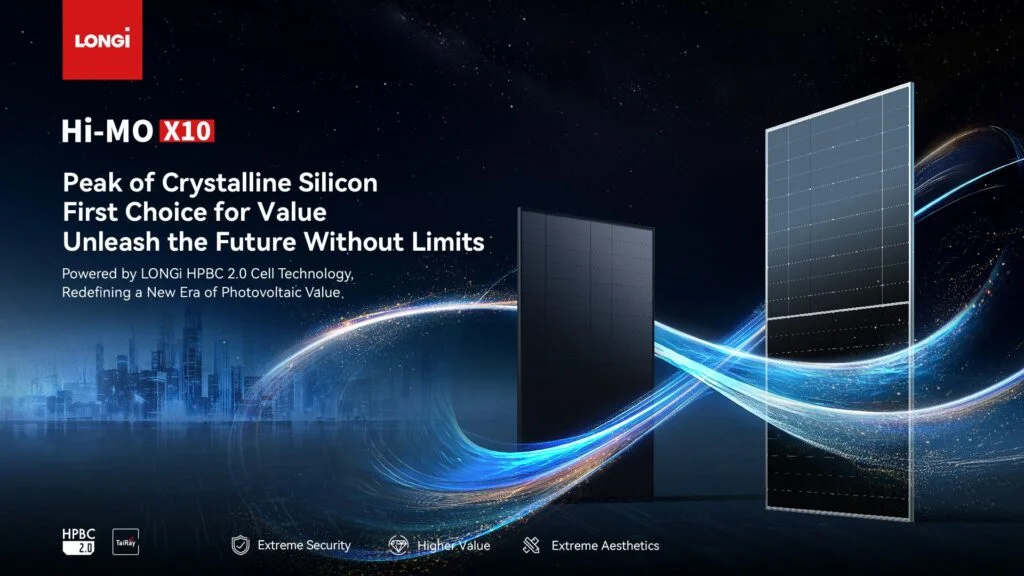
The Hi-MO X10 is LONGi’s flagship back-contact module, built around the company’s second-generation HPBC 2.0 cell platform — short for Hybrid Passivated Back Contact. LONGi is the world’s largest producer of monocrystalline silicon wafers, and the X10 is essentially that wafer expertise pushed into a panel that behaves quite differently from the TOPCon modules most Pakistani installers are already used to handling.
Three things separate HPBC 2.0 from older N-type TOPCon designs:
- TaiRay wafers – a proprietary n-type silicon wafer LONGi says improves light absorption and lowers internal resistance compared with standard wafers.
- Zero-busbar (0BB) cell structure – removing the visible metal busbars on the cell surface cuts shading losses and gives the panel a clean, unbroken black finish.
- Bipolar Hybrid Passivation – a passivation technique applied to both the p-type and n-type sides of the cell, which lifts open-circuit voltage to roughly 745mV, about 15mV higher than typical TOPCon cells.
This isn’t just a marketing exercise, either. The Hi-MO X10 won the Smarter E AWARD 2025 in the Photovoltaics category at Intersolar Europe — LONGi was the only Chinese manufacturer to take that award that year — and TÜV Rheinland separately certified it Class A for shadow resistance. For buyers in Pakistan who usually have no easy way to verify a dealer’s performance claims, that kind of independent, third-party validation is worth knowing about before paying a premium for the panel.
LONGi Hi-MO X10 Price in Pakistan – Latest Rates (June 2026)
Pricing on the Hi-MO X10 moves with every shipment that clears customs, so two dealers quoting on the same day can land two or three rupees per watt apart simply based on when they bought their stock. Based on rates gathered from multiple authorized LONGi resellers across Lahore, Karachi, and Islamabad through May and June 2026, here is a representative breakdown by wattage:
| Hi-MO X10 Variant | Power Output | Configuration | Approx. Price/Watt (PKR) | Approx. Panel Price (PKR) |
|---|---|---|---|---|
| HPBC 2.0 Monofacial | 640W | N-type, single glass | 36 | 23,040 |
| HPBC 2.0 Monofacial | 650W | N-type, single glass | 37 | 24,050 |
| HPBC 2.0 Bifacial | 655W | N-type, dual glass | 39 | 25,545 |
| HPBC 2.0 Bifacial | 660W | N-type, dual glass | 40 | 26,400 |
| HPBC 2.0 Bifacial | 670W | N-type, dual glass | 42 | 28,140 |
Treat this as a current market range rather than a fixed sticker price. Always ask for the same-day per-watt rate and the total invoice amount before paying — a low per-watt figure sometimes hides extra charges added later at checkout.
Monofacial vs Bifacial Hi-MO X10: Which One Actually Makes Sense
Queries like longi himo x10 bifacial price in pakistan and longi himo x10 monofacial price in pakistan come up constantly, and the distinction matters more than the price gap suggests.
Monofacial panels generate power from the front surface only and are the simpler, slightly cheaper option — a sensible choice for a standard rooftop mount where the back of the panel sits flush against the structure with no light reaching it anyway. Bifacial panels use a transparent rear surface to capture reflected and diffused light, typically adding somewhere in the 5–20% range of extra output, depending on the mounting height and what’s underneath the array (white roofing or light gravel reflects far more light than bare concrete or grass).
Ground-mounted systems and elevated commercial installations in Pakistan tend to get noticeably more out of the bifacial variant simply because there’s open space and reflective surface beneath the panel. A typical flush residential rooftop won’t see anywhere near that gain — which is part of why several Pakistani dealers price the monofacial Hi-MO X10 only slightly below the bifacial version rather than offering a steep discount for it.
Complete Technical Specifications
| Specification | Detail |
|---|---|
| Cell technology | N-type HPBC 2.0 (Hybrid Passivated Back Contact) |
| Wafer | TaiRay monocrystalline silicon |
| Busbar design | 0BB (zero busbar) |
| Power range (Pakistan market) | 640W – 670W |
| Module efficiency | Up to 24.8% |
| Cell efficiency | Up to 26.6% |
| Bifaciality (bifacial variant) | ~70% ± 5% |
| Open-circuit voltage | Up to ~745mV per cell |
| Temperature coefficient | -0.26%/°C |
| First-year degradation | ~1% |
| Annual degradation (year 2 onward) | ~0.35% |
| Power retained after 30 years | ~88.85% |
| Module dimensions (670W glass-glass) | 2382 × 1134 × 30 mm |
| Cell count | 144 half-cut back-contact cells |
| Product warranty | Typically 12–15 years (confirm with dealer) |
| Performance warranty | 25–30 years, linear |
| Certifications | TÜV Rheinland Class A shadow-resistance; Smarter E AWARD 2025 winner |
What’s Actually Driving the Hi-MO X10 Price in Pakistan Right Now
A handful of factors decide what a dealer quotes on any given day, and most of them have nothing to do with the panel’s sticker price abroad:
- PKR-to-USD exchange rate – panels are invoiced largely in dollars, so currency swings show up in the rupee price within days.
- Import duties and sales tax – any change in customs valuation or GST on solar components feeds straight into landed cost.
- Shipment and batch timing – a dealer working through a batch that cleared customs three months ago is operating on an older cost basis than one who just received a fresh container, which is exactly why “today’s price” genuinely differs from seller to seller.
- Cell configuration – bifacial dual-glass variants cost more to manufacture and ship than monofacial single-glass panels of similar wattage, simply because there’s more glass and more weight involved.
- Distance from port – freight from Karachi adds a small premium the further inland a buyer is; dealers in Peshawar, Multan, or Gilgit-Baltistan typically quote a few rupees per watt above Karachi rates.
- Dealer authenticity – authorized distributors who register the warranty and can verify the serial number tend to price a little above grey-market sellers offering unverifiable “branded” stock.
Hi-MO X10 vs Other LONGi Models
| Model | Cell Type | Power Range | Module Efficiency | Annual Degradation | Best Use Case |
|---|---|---|---|---|---|
| Hi-MO 5 | P-type Mono PERC | 540–555W | ~21% | ~0.55% | Budget residential |
| Hi-MO 6 | P-type Mono | 555–585W | ~21.5% | ~0.50% | Standard residential |
| Hi-MO 7 | N-type TOPCon | 580–610W | ~22.8–23.3% | ~0.40% | Residential & commercial |
| Hi-MO 9 | N-type TOPCon | 610–670W | ~24.0–24.8% | ~0.40% | Large-scale & commercial |
| Hi-MO X10 | N-type HPBC 2.0 | 640–670W | Up to 24.8% | ~0.35% | Space-constrained & premium installs |
Hi-MO X10 vs Competing Brands in Pakistan
| Brand & Series | Cell Type | Approx. Price/Watt (PKR, mid-2026) |
|---|---|---|
| LONGi Hi-MO X10 | N-type HPBC 2.0 | 36–42 |
| LONGi Hi-MO 7 | N-type TOPCon | 33–39 |
| Jinko Tiger Neo | N-type TOPCon | 38–44 |
| Canadian Solar TOPCon | N-type TOPCon | 40–46 |
All four are Tier-1 manufacturers, and the honest takeaway from comparing dozens of dealer rate sheets is that documentation matters more than brand. A-grade, fully documented panels with a verifiable serial number consistently command a higher and more stable price than undocumented stock of the same wattage — regardless of which logo is printed on the glass. The choice between these brands in Pakistan usually comes down to which authorized dealer has stock on hand, not a meaningful performance gap between them.
Check out Solar Panel Per watt price in Pakistan today
Total Cost of a Solar System Using Hi-MO X10 Panels
Panel cost is only part of the bill. Inverter, mounting structure, wiring, protection devices, and labor typically add more to the final invoice than the panels themselves, especially once a battery is involved.
| System Size | Panels Needed (≈650W each) | Panel-Only Cost | Installed Cost (grid-tied) | Installed Cost (hybrid + battery) |
|---|---|---|---|---|
| 3 kW | ~5 | ~Rs. 120,000 | ~Rs. 450,000 – 550,000 | ~Rs. 650,000 – 850,000 |
| 5 kW | ~8 | ~Rs. 190,000 | ~Rs. 650,000 – 800,000 | ~Rs. 950,000 – 1,250,000 |
| 10 kW | ~15–16 | ~Rs. 380,000 | ~Rs. 1,100,000 – 1,400,000 | ~Rs. 1,700,000 – 2,200,000 |
These are ballpark, indicative figures pulled together from multiple installer rate sheets — actual quotes vary with inverter brand, structure type (ground-mount vs elevated), battery chemistry, and the installer’s labor rates in a given city. Getting two or three itemized quotes before signing anything is the only way to know the real number for a specific roof.
Net Billing 2026: How Pakistan’s Updated Solar Policy Changes the Math
For years, Pakistan’s net metering rules let solar owners export surplus power to the grid and get credited unit-for-unit against what they pulled back later, effectively letting the grid double as a free battery. That changed in February 2026, when NEPRA notified the Prosumer Regulations 2026, replacing one-to-one net metering with a net billing model. Under the new system, distribution companies buy exported electricity at the National Average Energy Purchase Price — roughly Rs. 11–13 per unit — instead of crediting it at the full retail tariff, which had been running closer to Rs. 22–27 per unit.
The reversal triggered enough pushback from installers and existing solar owners that the Prime Minister’s office intervened within a week, and NEPRA issued a grandfathering clause protecting anyone with an existing net metering agreement for the remaining term of their contract. New installations from February 9, 2026 onward, however, fall under the net billing framework.
In practical terms, exporting unused daytime power back to the grid is now worth roughly half of what it used to be, so the financial case for solar leans much more heavily on self-consumption than on selling surplus back. That shift is a large part of why hybrid systems with battery storage have picked up interest over plain grid-tied setups since the policy changed, even though they cost more upfront. A high-efficiency panel like the Hi-MO X10 still pays back faster than older modules simply because it produces more usable energy per square meter of roof — but the payback math now depends more on daytime usage habits than it did under the old regime.
Key Benefits of Choosing the Hi-MO X10 in Pakistan
- Higher yield per square meter — fewer panels are needed to hit a target capacity, which matters on Pakistan’s typically compact urban rooftops.
- Better heat performance — the -0.26%/°C temperature coefficient means less output loss during Punjab and Sindh’s 45°C-plus summer peaks compared with older PERC-based panels.
- Dust resilience — the anti-soiling coating reduces the output drop caused by fine dust settling on rooftops in cities like Multan, Bahawalpur, and DI Khan between cleanings.
- Shading tolerance — the built-in anti-shading optimizer limits power loss when a tree, parapet wall, or water tank casts a partial shadow across part of the array, a common issue on dense urban rooftops.
- Long service life — a 25–30-year linear performance warranty, where properly registered by the dealer, gives a long runway to recover the higher upfront cost.
- Cleaner aesthetics — the all-black, busbar-free surface is a genuine selling point on visible rooftop installations for upscale residential projects.
Where the Hi-MO X10 Fits Best
- Residential rooftops with limited space, where maximizing capacity without covering the entire roof matters.
- Commercial buildings such as offices, retail outlets, and warehouses, where fewer panels mean faster installation and less mounting hardware.
- Industrial and off-grid projects, where high per-panel output reduces the total panel count needed for large arrays.
- Hybrid battery systems, where self-consumption matters more than grid export under the new net billing rules.
How to Buy a Genuine Hi-MO X10 in Pakistan
- Buy only through AEDB-registered installers or distributors officially listed by LONGi — counterfeit panels carrying fake LONGi stickers have circulated in some local markets.
- Ask for the panel’s serial number and cross-check it on LONGi’s official website before paying anything.
- Get the warranty terms in writing, with the dealer’s registration details attached, rather than relying on a verbal “25-year” promise.
- Compare the quoted per-watt rate against the total invoice — a low per-watt figure sometimes hides additional charges added later.
- Treat an unusually low quote as the biggest red flag in the entire process; with a specialized panel like this, prices well below the going market rate are rarely a genuine bargain.
- Where possible, choose a dealer who can also handle inverter sizing and net billing paperwork, since the inverter has to be matched correctly for an HPBC 2.0 module to perform at its rated output.
Frequently Asked Questions
What is the LONGi Hi-MO X10 price in Pakistan today?
As of June 2026, it generally costs between Rs. 36 and Rs. 42 per watt, or roughly Rs. 23,000 to Rs. 28,000 per panel, depending on wattage and whether it’s the monofacial or bifacial version. The exact figure shifts with currency movement and import batches, so the same-day dealer quote is the only fully reliable number.
Is the Hi-MO X10 better than the Hi-MO 7?
The Hi-MO X10 generally delivers higher module efficiency (up to 24.8% versus roughly 23.3%) and a slightly lower annual degradation rate, making it the stronger long-term performer. The Hi-MO 7 remains a reasonable option for buyers who’d rather keep the upfront cost lower than chase maximum yield.
What’s the real difference between monofacial and bifacial Hi-MO X10 panels?
Monofacial panels generate power from the front face only and cost a bit less. Bifacial panels also capture reflected light from the rear, adding roughly 5–20% extra output — but mainly on elevated or ground-mounted installs with reflective surfaces underneath; a flush rooftop mount sees a much smaller gain.
How long is the warranty on a LONGi Hi-MO X10 panel?
LONGi’s typical structure for the X10 series pairs a 12–15-year product warranty with a 25–30-year linear performance warranty, though exact terms can vary by import batch and dealer. It’s worth getting the warranty document in writing rather than relying on a verbal claim.
Does Pakistan’s 2026 net billing policy make solar less worthwhile?
Not necessarily — it changes where the value comes from. Exported electricity is now credited at roughly half the old rate, so the financial case shifts toward maximizing self-consumption and pairing panels with battery storage rather than relying on grid export credits.
Where can someone buy a genuine LONGi Hi-MO X10 in Pakistan?
Through AEDB-registered installers or LONGi’s officially listed distributors, after verifying the panel’s serial number on LONGi’s website. Open markets and unusually discounted roadside sellers carry a higher risk of counterfeit or mislabeled stock.
Final Verdict
The Hi-MO X10 isn’t the cheapest panel on Pakistan’s market, and it doesn’t need to be — higher efficiency, a smaller footprint per kilowatt, and award-winning anti-shading and heat performance are the entire pitch. For someone with generous roof space who’s prioritizing price above everything else, an older Hi-MO 7 or a lower-priced Tier-1 competitor probably makes more financial sense. But for space-constrained rooftops, premium residential builds, or commercial sites where reducing the panel count saves on mounting and wiring costs, the Hi-MO X10’s price premium is generally justified by what it delivers over a 25-to-30-year service life — particularly now that Pakistan’s net billing rules make self-generated, self-consumed power more valuable than ever.