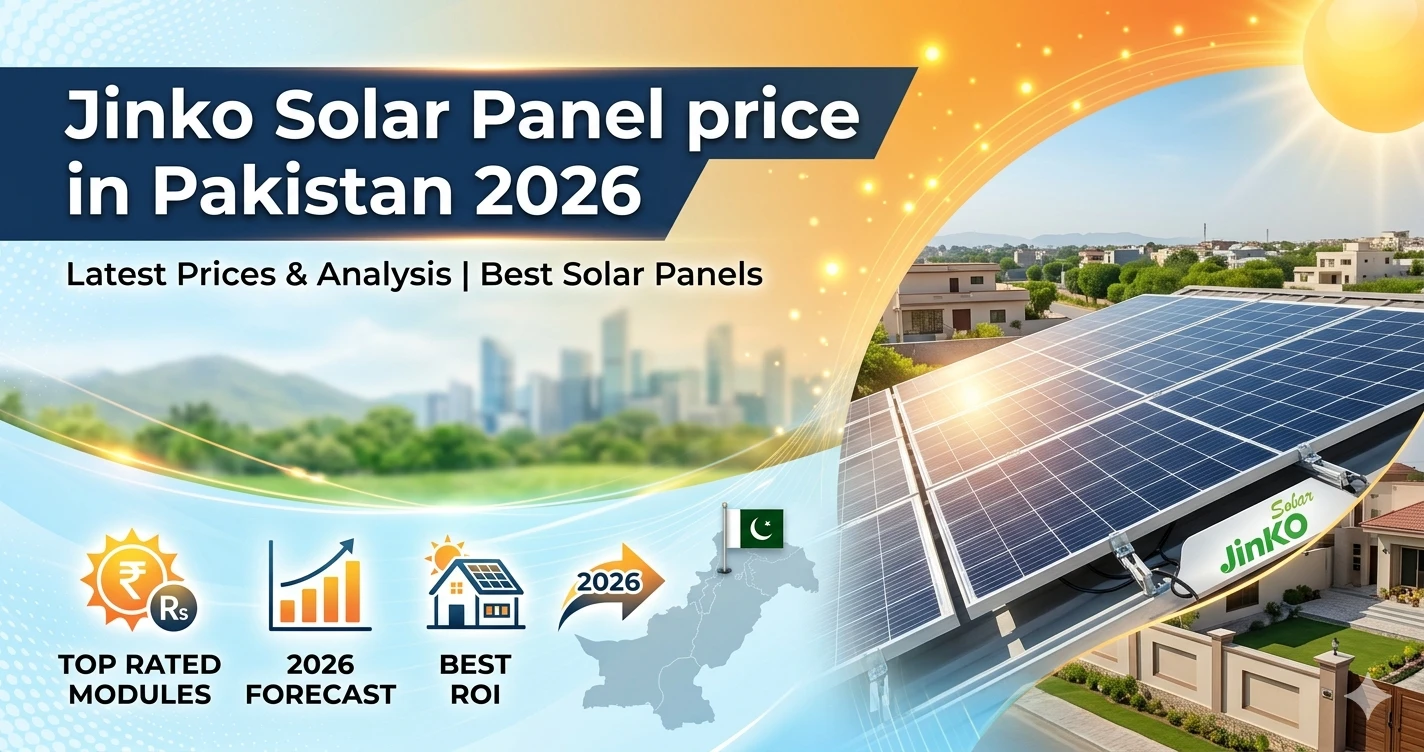
Jinko Solar Panel Price in Pakistan 2026 — All Models, System Costs & Buying Guide
Pakistan’s electricity crisis is real. Monthly WAPDA bills have crossed Rs. 60 per unit for high-slab residential consumers, and load shedding continues to disrupt daily life from Multan to Peshawar. In this environment, solar energy has shifted from a luxury to a genuine household necessity — and Jinko Solar panels have become one of the most trusted, most searched, and most installed brands across the country.
This guide gives Pakistani homeowners and business owners a complete, honest, and up-to-date breakdown of Jinko solar panel price in Pakistan in 2026. It covers every model, explains the technology behind N-Type and P-Type panels, compares per-watt rates across brands, and walks through what a complete solar system actually costs from purchase to installation — no fluff, no guesswork.
Why Jinko Solar Dominates Pakistan’s Market in 2026
Before diving into prices, it is worth understanding why this brand consistently tops buyer searches and installer recommendations.
Jinko Solar is a Tier-1 global manufacturer with over 100 GW of panels shipped to more than 160 countries. Its Tiger Neo series, built on N-Type TOPCon cell architecture, delivers efficiency ratings reaching up to 22.65% — among the highest available in Pakistan’s retail market today. For a country where rooftop space is limited and summer temperatures regularly push past 45°C in cities like Multan and Faisalabad, those numbers matter enormously.
Three factors drive Jinko’s dominance in Pakistan specifically:
- First, supply reliability. Jinko maintains a strong distribution network through authorized dealers in Karachi, Lahore, Islamabad, Faisalabad, and Multan. During peak summer demand, when cheaper brands run out of verified stock, Jinko panels remain consistently available with full documentation.
- Second, warranty depth. Jinko’s N-Type Tiger Neo models carry a 30-year linear power performance guarantee — the longest in the industry — ensuring at least 87.4% of rated output after three decades of operation. Competitor brands typically offer 25 years.
- Third, verifiability. Jinko’s FlashTrack app lets any buyer scan a panel’s QR code or enter its serial number to confirm it is factory-registered, genuine, and under warranty. In a market where B-grade and grey-market panels are widely circulated, this authentication system provides real peace of mind.
Jinko Solar Panel Price in Pakistan — June 2026 (Updated Rates)
Jinko Solar Panel Price in Pakistan fluctuate daily due to shifts in the USD/PKR exchange rate, import duties, and seasonal demand. The rates below reflect current wholesale and dealer market conditions as of late June 2026. Always confirm final pricing with an authorized dealer before purchasing.
Jinko N-Type TOPCon Panels (Best Performance)
These are the current top-tier panels and the recommended choice for new residential and commercial installations in 2026.
| Model | Wattage | Technology | Price Per Watt (PKR) | Approx. Panel Price (PKR) |
|---|---|---|---|---|
| Tiger Neo JKM580N | 580W | N-Type Bifacial | Rs. 42–45 | Rs. 24,360–26,100 |
| Tiger Neo JKM585N | 585W | N-Type Bifacial | Rs. 42–45 | Rs. 24,570–26,325 |
| Tiger Neo JKM590N | 590W | N-Type Bifacial | Rs. 43–45 | Rs. 25,370–26,550 |
| Tiger Neo JKM610N | 610W | N-Type Monofacial | Rs. 43–46 | Rs. 26,230–28,060 |
| Tiger Neo JKM615N | 615W | N-Type Bifacial | Rs. 43–47 | Rs. 26,445–28,905 |
| Tiger Neo JKM705N | 705W | N-Type Bifacial | Rs. 44–47 | Rs. 31,020–33,135 |
| Tiger Neo JKM720N | 720W | N-Type Bifacial | Rs. 44–47 | Rs. 31,680–33,840 |
Jinko P-Type Mono PERC Panels (Budget-Friendly)
These panels suit buyers who need reliable Tier-1 performance at a lower upfront cost.
| Model | Wattage | Technology | Price Per Watt (PKR) | Approx. Panel Price (PKR) |
|---|---|---|---|---|
| Tiger Pro | 500W | P-Type Mono PERC | Rs. 28–32 | Rs. 14,000–16,000 |
| Tiger Pro | 540W | P-Type Mono PERC | Rs. 28–33 | Rs. 15,120–17,820 |
| Tiger Pro | 550W | P-Type Mono PERC | Rs. 29–33 | Rs. 15,950–18,150 |
| Tiger Pro | 560W | P-Type Mono PERC | Rs. 30–34 | Rs. 16,800–19,040 |
Disclaimer: All prices are approximate market reference rates for June 2026. Final prices vary by city, dealer margin, order quantity, documentation, and daily USD/PKR movements. Always confirm with an authorized Jinko dealer before placing your order.
N-Type vs P-Type — Which Jinko Panel Should You Buy in Pakistan?
This is the single most important question for a Pakistani buyer in 2026. Here is a clear, side-by-side breakdown:
| Feature | N-Type TOPCon (Tiger Neo) | P-Type Mono PERC (Tiger Pro) |
|---|---|---|
| Cell Efficiency | Up to 22.65% | 20–21% |
| Annual Degradation | ~0.40% per year | ~0.55% per year |
| Output After 25 Years | ~90% | ~86% |
| Performance in Heat | Excellent | Good |
| Low-Light Performance | Superior | Moderate |
| Price Per Watt | Rs. 42–47 | Rs. 28–34 |
| Warranty | 30 years | 25 years |
| Best For | Homes, commercial, long-term ROI | Budget buyers, smaller setups |
Verdict: For any installation above 3kW, the N-Type panels deliver meaningfully better returns over a 10–25 year horizon. The Rs. 10–12 per watt difference in upfront cost is recovered within 2–3 years through higher energy generation, especially in Pakistan’s intense summer sun.
Jinko vs Other Top Brands — Price Comparison (June 2026)
One of the most common questions asked in solar markets across Lahore’s Hall Road, Karachi’s Saddar, and Rawalpindi’s College Road is how Jinko stacks up against the competition on price and value.
| Brand | Technology | Per Watt Rate (June 2026) | Notable Strength |
|---|---|---|---|
| Longi (Hi-Mo 7) | N-Type Bifacial | Rs. 40–44.50 | Most popular in Pakistan, 25yr warranty |
| Jinko (Tiger Neo) | N-Type Bifacial | Rs. 42–45 | Highest efficiency, 30yr warranty |
| JA Solar (DeepBlue) | N-Type Bifacial | Rs. 40–44.50 | Excellent value, strong availability |
| Canadian (TopCon/HJT) | N-Type/HJT Bifacial | Rs. 48–49.60 | Premium commercial grade |
| Trina (Vertex N) | N-Type Mono | Rs. 42–47 | High efficiency, trusted brand |
| Astronergy | N-Type TOPCon | Rs. 40–47 | Newer entrant, competitive pricing |
| Aiko Solar | ABC Technology | Rs. 33–36 | Industry-leading ABC cell efficiency |
Among these, Longi and Jinko consistently lead installer recommendations for residential projects because of their combination of documented supply, warranty support, and efficiency in Pakistan’s hot climate.
Also Read: Today Solar Panel Price in Pakistan 20 Oct 2026
Complete Solar System Price in Pakistan 2026 (With Jinko Panels)
Panels are only one piece of the puzzle. A complete solar system includes a quality inverter, mounting structure, DC and AC cabling, protection components, and professional installation. For hybrid systems, a battery bank adds significant cost but provides backup during load shedding — which remains a critical requirement for most Pakistani households.
On-Grid Solar System Prices (With Net Metering)
| System Size | Suited For | Estimated Price (PKR) | Daily Units Generated |
|---|---|---|---|
| 3kW | 2 BHK flat, basic loads | Rs. 424,000–550,000 | 10–12 units |
| 5kW | Average family home | Rs. 600,000–800,000 | 18–22 units |
| 10kW | Large home, joint family | Rs. 1,000,000–1,200,000 | 35–45 units |
| 15kW | Commercial/large home | Rs. 1,400,000–1,800,000 | 55–65 units |
| 20kW | Industrial/heavy commercial | Rs. 1,800,000–2,400,000 | 75–90 units |
Hybrid Solar System Prices (With Battery Backup)
| System Size | Price Without Batteries | Price With Lithium Batteries | Price With Tubular Batteries |
|---|---|---|---|
| 5kW | Rs. 600,000–800,000 | Rs. 900,000–1,100,000 | Rs. 750,000–900,000 |
| 10kW | Rs. 1,000,000–1,200,000 | Rs. 1,500,000–2,000,000 | Rs. 1,300,000–1,630,000 |
| 12kW | Rs. 1,200,000–1,400,000 | Rs. 1,800,000–2,300,000 | Rs. 1,500,000–1,900,000 |
Solar Inverter Prices in Pakistan 2026
The inverter is the heart of any solar system. Inverter brands like Solis, Growatt, Goodwe, and Huawei are widely used in Pakistan.
| Inverter Capacity | Type | Price Range (PKR) |
|---|---|---|
| 3kW | On-Grid | Rs. 55,000–90,000 |
| 5kW | On-Grid (Solis, Goodwe) | Rs. 120,000–160,000 |
| 5kW | Hybrid | Rs. 180,000–240,000 |
| 10kW | On-Grid | Rs. 200,000–280,000 |
| 10kW | Hybrid (Huawei/Growatt) | Rs. 300,000+ |
Note: Net metering registration with your local DISCO (LESCO, MEPCO, IESCO, HESCO, etc.) currently costs approximately Rs. 140,000–160,000 as a one-time fee and takes 2–4 weeks when handled by an experienced installer.
What Affects Jinko Solar Panel Price in Pakistan?
Understanding the price drivers helps buyers make smarter purchasing decisions — and avoid being overcharged.
1. USD/PKR Exchange Rate Most solar panels in Pakistan are imported from China. When the rupee weakens against the dollar, landed import costs rise, and dealers adjust their rates accordingly. In June 2026, relative stability in the exchange rate has kept N-Type panel prices from rising sharply.
2. Import Duties and Regulatory Charges The government has reduced some import duties on solar equipment to promote renewable energy adoption, but regulatory duties and sales tax still contribute a 10–15% variance in final pricing depending on the documentation status of a shipment.
3. Panel Grade — A-Grade vs B-Grade A-Grade panels are defect-free, come with full manufacturer documentation, and are imported through registered channels. B-Grade panels carry visual flaws, slightly lower output, and no manufacturer warranty. For any home or commercial installation designed to last 20+ years, A-Grade documented panels are the only sensible choice. B-Grade panels are suited for off-grid sheds, agricultural pumps, and temporary setups only.
4. Technology — N-Type vs P-Type As detailed above, N-Type TOPCon technology commands a Rs. 10–15 per watt premium over P-Type Mono PERC. This reflects genuine performance differences, not just marketing.
5. Seasonal Demand Solar demand in Pakistan peaks during summer (April–August) when electricity bills surge. Buying in the off-season (November–January) can save 5–8% on panel rates. However, given the long-term nature of the investment, the financial difference is relatively minor.
6. City and Dealer Margin Prices in Karachi, Lahore, and Islamabad wholesale markets tend to be slightly lower than in smaller cities due to economies of scale and competition. Retail dealer margins can add 5–15% above wholesale rates.
How Many Solar Panels Do You Need? (Pakistan-Specific Guide)
This is a practical question that depends on monthly electricity consumption and system type.
| Monthly Bill (PKR) | Avg. Monthly Units | Recommended System | Panels Needed (580W) |
|---|---|---|---|
| Rs. 8,000–15,000 | 150–300 units | 3kW On-Grid | 5–6 panels |
| Rs. 15,000–30,000 | 300–600 units | 5kW Hybrid | 9–10 panels |
| Rs. 30,000–60,000 | 600–1,000 units | 8–10kW Hybrid | 14–18 panels |
| Rs. 60,000+ | 1,000+ units | 10–15kW Hybrid | 18–26 panels |
A standard 1,350 sq ft home in Pakistan typically needs 10–14 panels of 580W each to fully offset grid electricity usage. To run a 1.5-ton inverter AC on solar, approximately 4 panels of 580 watts each are required during peak sun hours.
Net Metering in Pakistan 2026 — What Jinko Users Need to Know
Net metering allows solar system owners to feed excess electricity back into the national grid and receive billing credits. Under NEPRA’s updated Solar Prosumer Regulations 2026, existing net metering users with valid agreements are fully protected and continue under their original terms.
For new applicants in 2026, the key change to understand is that self-consumed solar electricity now delivers significantly more value than exported units. The per-unit saving on self-consumption is Rs. 33–48 (depending on your DISCO and consumption slab), while exported units are credited at roughly Rs. 11 per unit. This makes hybrid systems with battery storage the smarter investment for new buyers — maximize what you use at home, minimize what you export.
A well-designed 10kW on-grid system generates approximately 38 units per day, which is enough to reduce a heavy-usage household bill to near zero with proper system sizing and usage management.
How to Check If Your Jinko Panel Is Genuine
Pakistan’s solar market has a documented grey-market problem. Fake or unregistered Jinko panels are circulated, particularly through unlicensed dealers. Before any purchase:
- Download Jinko’s FlashTrack app (available for Android) or visit flashtrack.jinkosolar.com
- Scan the QR code on the panel’s rear label or enter the serial number manually
- The portal confirms the model, wattage, manufacturing date, and warranty status
- If the serial number returns no result, reject the panel immediately
- Also request and review the PSI (Pre-Shipment Inspection) and COC (Certificate of Conformity) import documents
- Only buy from AEDB-listed authorized distributors
Reliable authorized distributors in Pakistan include Power House Express, Nizam Energy, JNS International, Rameen Solar Energy, and Solar Trade PK.
Return on Investment — Is Jinko Solar Worth It in Pakistan in 2026?
The financial case for solar has never been stronger in Pakistan.
With A-Grade Tier-1 N-Type panels now available at Rs. 38–45 per watt — compared to Rs. 80–90 per watt in 2023 — prices have dropped more than 50% in three years. Meanwhile, WAPDA electricity tariffs continue rising. The combination produces compelling ROI numbers:
- Average payback period for a 5kW system: 3–4 years (on-grid) / 4–6 years (hybrid)
- Monthly savings on a Rs. 40,000 electricity bill: Rs. 25,000–38,000
- System lifespan: 25–30 years
- Post-payback free energy generation: 20+ years
For homeowners paying Rs. 30,000 or more monthly in electricity bills, a properly sized solar system is one of the strongest financial investments available in Pakistan today. Solar panels also hold their value — and frequently increase property resale value.
City-Wise Buying Tips
Lahore: Hall Road remains the main wholesale hub. Competition is fierce, meaning prices are competitive. Always ask for documented A-Grade panels and verify serials on the spot.
Karachi: Saddar market and New Karachi industrial areas. Coastal humidity makes double-glass bifacial panels a better long-term choice. Check that mounting structures are corrosion-resistant.
Islamabad/Rawalpindi: College Road and Raja Bazaar are main dealer zones. On-grid systems are popular here due to relatively fewer power outages compared to other cities.
Multan/Faisalabad: Higher temperatures mean N-Type panels with lower temperature coefficients are especially worth the premium. Avoid P-Type in areas where daily highs regularly exceed 42°C.
Peshawar/Quetta: Colder winters and shorter days in some months mean slightly lower annual generation. Factor this into system sizing.
Frequently Asked Questions
What is the Jinko solar panel price in Pakistan per watt right now?
As of June 2026, Jinko N-Type TOPCon panels (Tiger Neo series) are priced between Rs. 42 and Rs. 47 per watt from authorized dealers. P-Type Mono PERC models start from Rs. 28 per watt.
Is Jinko Solar better than Longi in Pakistan?
Both are globally Tier-1 manufacturers. Jinko’s Tiger Neo edges ahead on maximum efficiency and offers a 30-year warranty versus Longi’s 25 years. Longi Hi-Mo 7 is slightly more widely available and marginally cheaper. For residential use, either is an excellent choice. For commercial projects where maximum output per square foot matters, Tiger Neo has a slight edge.
What is the price of a complete 5kW solar system with Jinko panels in 2026?
A complete 5kW hybrid system using Jinko N-Type panels, a quality inverter, mounting structure, wiring, and installation costs approximately Rs. 700,000–900,000 depending on inverter brand and whether batteries are included.
How long do Jinko solar panels last in Pakistan’s climate?
Jinko’s N-Type Tiger Neo panels are rated for 30-year performance with 87.4% minimum output guaranteed. Pakistan’s high irradiance actually benefits total energy generation, though high temperatures slightly affect efficiency in peak summer — which is precisely where N-Type panels outperform P-Type models.
Can I run my 1.5-ton AC on solar?
Yes. A 1.5-ton inverter AC requires approximately 1.5–1.8kW during operation. With 4 panels of 580W each (approximately 2.3kW installed capacity), you can comfortably run the AC during daylight hours. For 24-hour cooling, a hybrid system with battery backup is required.
Are solar panel prices in Pakistan going to decrease further in 2026?
Current market demand in Pakistan is relatively low due to seasonal factors, which has softened prices slightly. Analysts expect prices to remain stable through 2026 barring major USD/PKR shifts or new import duty changes. Buying now versus waiting is unlikely to produce dramatic savings.
Final Recommendation
For most Pakistani homeowners in 2026, the recommended setup is a 5kW to 10kW hybrid solar system using Jinko Tiger Neo N-Type 580W or 585W Bifacial panels, paired with a quality hybrid inverter (Growatt, Goodwe, or Huawei) and a lithium battery bank sized to cover 6–8 hours of essential loads.
This combination delivers the best long-term return on investment, genuine energy independence during load shedding, and a warranty structure (30 years on panels, 10 years on most inverters) that protects the investment for decades.
Always buy from authorized, AEDB-listed dealers. Always verify panel authenticity via FlashTrack before installation. And always get a written warranty document — not just a verbal assurance.
Prices in this article are based on market data from Lahore, Karachi, and Islamabad wholesale and dealer markets as of June 2026. Solar panel prices fluctuate daily. Always confirm final rates with an authorized dealer before purchase. The author has compiled this data from multiple verified market sources for informational purposes only.